

The Development Itinerary: 24 Iterations in Four Weeks
By Miltos Vafiadis
Διαβάστε το και στα ελληνικά.
Volume II is out: 25 more stops, and the day the app went public.
Somewhere on the About page of this site there's been a "fuller write-up coming soon" promise sitting patiently since week one. This is that write-up — or at least the first installment of it. And since PlanItShare is a trip-planning app, there was really only one honest way to tell the story of how it got built: as an itinerary.
Four weeks. Twenty-four iterations. Five legs. One traveler — me — with an AI pair-programmer (Claude Code) doing a serious share of the driving, and me doing what I keep telling my students the engineer's actual job is: deciding where we're going, checking the work, and refusing to merge anything I couldn't defend on a whiteboard.
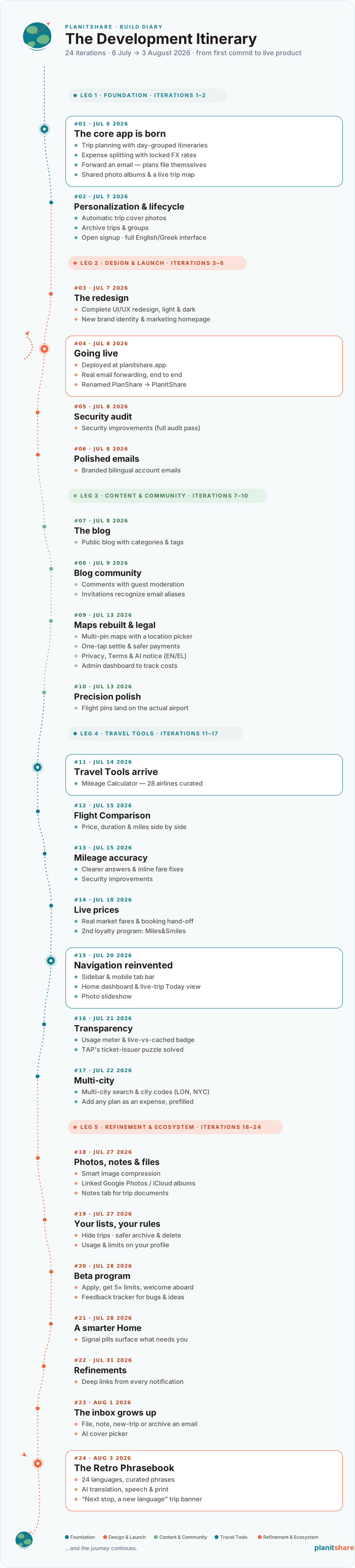
Here's the full route — scroll slowly, every stop is real, dated, and shipped. Tap the map to open it full-size in its own tab.
Leg 1 — Foundation (iterations 1–2)
The first stop is the biggest suitcase on the trip: trips with day-grouped itineraries, expense splitting with exchange rates locked on the day you spent the money, shared photo albums, a live map — and the feature that started the whole project, email import. Forward a flight confirmation to the app and your plans file themselves into the right trip. Iteration 2 added the quality-of-life layer: automatic cover photos, archiving, open signup, and a fully bilingual English/Greek interface. Not a translation bolted on later — built in from the second day.
Leg 2 — Design & Launch (iterations 3–6)
Iteration 3 threw out the developer-grade UI and replaced it with a proper design system, light and dark, plus the brand identity you're looking at right now. Iteration 4 is the big pin on the map: planitshare.app went live, with real email forwarding working end to end. Iteration 5 is the least glamorous stop on any itinerary — a full security audit, the travel equivalent of the rest day where you do laundry. Every trip needs one. Iteration 6 made the emails you receive from the app look like they came from a product and not from a script.
Leg 3 — Content & Community (iterations 7–10)
A public blog (you're reading it), comments with guest moderation, invitations that recognize your email aliases, and a rebuilt trip map with multi-pin support and a location picker. Iteration 10 fixed the kind of bug that makes travel software fun: flight pins that geocoded "SKG" to a street in Sweden now land on the actual runway, thanks to a bundled dataset of about nine thousand airports.
Leg 4 — Travel Tools (iterations 11–17)
The longest leg, and the one where the app grew past its original spec. A mileage calculator with over fifty partner-airline earning tables curated by hand from the airlines' own pages — no guessed numbers, ever; when a source was ambiguous, the calculator says "unverified" instead of inventing a figure. Then a flight comparison tool that shows price, duration, and the miles you'd actually earn, side by side, on live market fares. Multi-city search, a second loyalty program, and — my favorite stop of the leg — iteration 15, which rebuilt the app's whole navigation around how a trip actually feels: planning, live, recap. Open a trip while you're on it and you get today's agenda, not a wall of every plan you ever made.
Leg 5 — Refinement & Ecosystem (iterations 18–24)
The leg where a product becomes a place: smart photo compression, a Notes tab for tickets and bookings, linked Google Photos albums, a beta tester program with a real feedback tracker, and an inbox that gives every forwarded email four futures — file it, save it as a note, spin up a whole new trip from it, or archive it. The final stop shipped the Retro Phrasebook: forty curated phrases in twenty-four languages, with phonetics in your own alphabet and a deliberately manual, step-back-from-autotranslate philosophy.
The numbers, for the skeptics
I teach computer science; I know the "sounds nice, show me the data" face. So: 24 iterations in 28 days. Two loyalty programs curated to full parity. One production database that has had every single migration reviewed before it ran. 1,027 translation keys in each language, kept in lockstep. And one rule that never bent: nothing ships without being exercised against the real, live system first.
What actually made this work
Not typing speed. Three habits: small iterations (every stop on that map was a shippable unit, not a milestone on a Gantt chart), written handoffs (each iteration ends with a document honest enough that the next session — human or AI — can pick up cold), and using the thing daily (most of the best fixes on the map started as "wait, that's wrong" during my own real trips).
The AI angle deserves its own post — what it's genuinely great at, where it needs an engineer standing over it, and why I think this workflow is what our profession looks like now. That one's next on the itinerary.
The whole trip on one page
For the sharers and the wall-poster people:
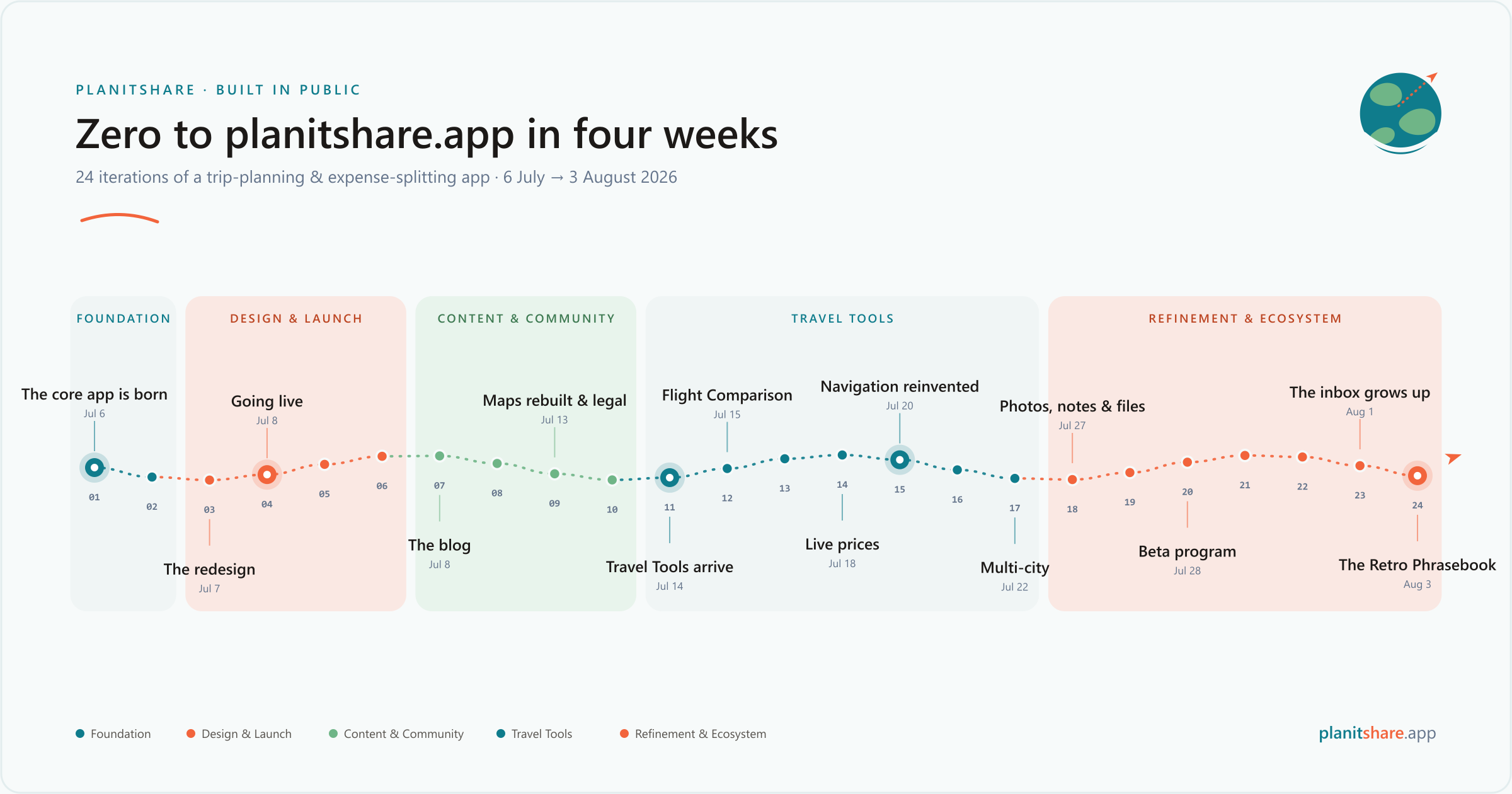
There's also a boarding pass for every single iteration — yes, all twenty-four, with seat numbers — which I'll be posting along the way on LinkedIn.
Want to see where the route goes next? Come aboard — or if you're already a passenger, the beta program is open from your dashboard. The journey continues.
Comments
No comments yet — be the first.